

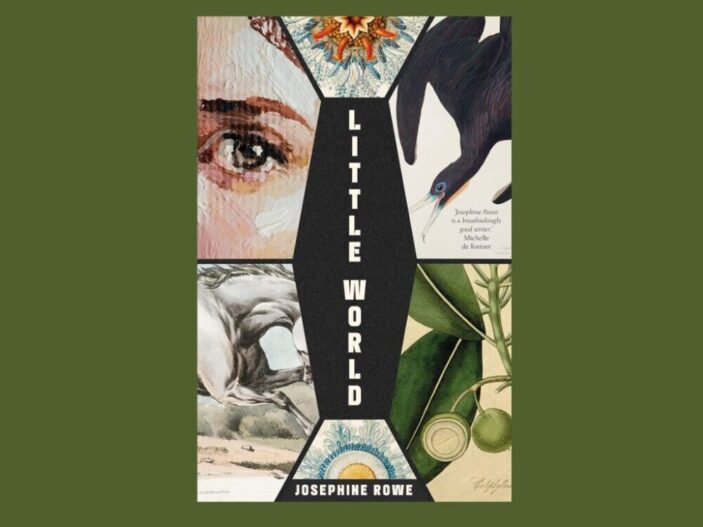
The ‘little world’ of the title in Josephine Rowe‘s latest novella refers to the sphere of consciousness of an unusual narrator. Arriving in a wooden box in the back of a horse float, she is a nameless girl, perhaps a saint, perhaps a miracle; but, certainly she is the body of a young girl who has died and for some inexplicable reason, has not begun to decay.
She arrives as part of a bequest – Kaspar Isaksen has ‘drunk himself to death’ and left her in the care of his friend Orrin Bird, a man living in seeming isolation in the northern part of Western Australia some time in the 1950s. While Orrin is not a particularly religious person, he keeps this un-canonised saint. If the gift of a dead girl in a box seems somehow abhorrent to Orrin, as it might to the reader, he does not show any signs of concern.
Under the guidance of Rowe’s carefully measured prose, the reader feels a certain sense of ease in following where the story leads as the plot makes several jumps through time. The book feels like three linked short stories that have been stitched together more than it does a novel. The through-line of the book, whatever it is, however is this girl, this supposed saint, who once lived in Panama with a sister. Her death may not have been as pure and holy as the fate of her body would suggest.
Her body travels from Panama to a Micronesian leper colony (Nauru), where her ‘owner’ hopes to have her status as a holy relic confirmed. The reader joins her as she then arrives in the Kimberley, where she explains that her awareness of her surroundings is complicated; describing that while her eyes may appear to be open due to the shrinking of the skin of her eyelids in the salt, she does not see or hear the things around her so much as she knows that things ‘are.’ She recounts a kind of personal history in a dispassionate, detached way, passing no judgement and leaving room for the reader to be the one to judge those who ‘possess’ her. One gets the sense that there was once a seething anger at the heart of her existence, which has now been replaced by a kind of resignation and weariness.
The second part of the book takes place some decades later when three women take shelter in an abandoned house. One of the trio, Mathilde, discovers the girl’s body, she feels herself inexplicably called to action, potentially in response to some recent trauma of her own. In the final part of the story, the reader comes across Mathilde years later as a much older woman, during the Covid pandemic in Victoria.
Earlier versions of both the beginning and end of the book were previously published as short fiction, and it seems that for the purpose of this book, Rowe has added the interlinking piece between. This means, of course, that the book comes with that particularly Australian short fictional hallmark, in that many elements are left open to interpretation and endings are often simply stopping points.
While some readers enjoy this style, some find it frustrating, and depending on which end of the spectrum you fall on, approach this book accordingly. If you enjoy clean, clear, powerful prose and imagery grounded in place, you will most likely enjoy the experience of being immersed in the world of Little World. But if you need to find out the ‘why’ behind character motivations, and you are expecting these to be slowly revealed, you will soon find there is not enough book for that to be the case. Much like the way our nameless saint interprets her surroundings, the people in this book and their actions simply are, and readers of this book must accept this style or find themselves frustrated.
As a fan of Rowe’s earlier collection, Here Until August, I enjoyed this brief foray into something a bit longer from this Stella-prize shortlisted and Elizabeth Jolley prize-winning writer. The stylistic choices to pare back the use of dialogue and the decision to eschew speech markers entirely, alongside the descriptions of rural Western Australia gave this book an almost Winton-esque feel.


FOUR STARS (OUT OF FIVE)
Josephine Rowe’s Little World is out now through Black Inc. Grab yourself a copy from your local bookstore HERE.
Header Image supplied by Black Inc.
