
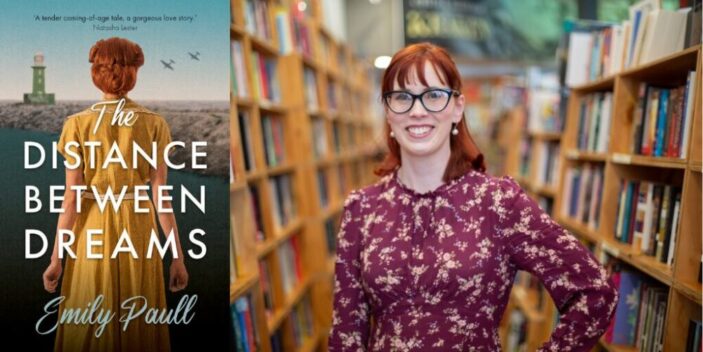
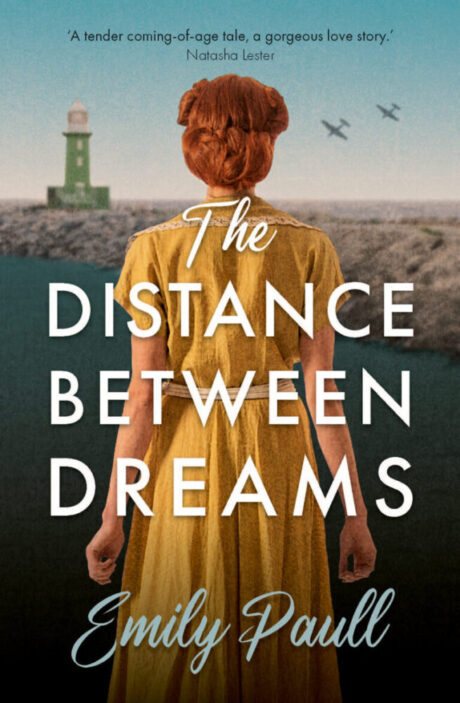
West Australian writer and AU review contributor Emily Paull saw the release of her debut novel The Distance Between Dreams, a stunning historical fiction of hope, dreams, and love, earlier this year.
Paull is a librarian, author, book reviewer, former bookseller, avid reader, huge supporter of the West Australia writing community, and a regular fixture at author events and writer interviews and festivals around Perth. Her debut collection of short fiction Well-Behaved Women was published in 2019 and her novel The Distance Between Dreams was shortlisted for the 2023 Fogarty Literary Award.
The novel tells the story of Sarah Willis, who longs to free herself from the expectations of a privileged upbringing, and Winston Keller who can’t afford the luxury of a dream. Despite their differences, the pair are drawn together in a whirlwind romance that defies the boundaries of class. But when a dark family secret pulls the young lovers apart, and WWII plunges the world into chaos, it seems impossible they will ever find their way back to each other – or even hold onto the dream of what might have been.
Emily took time out of her busy schedule to chat with us about The Distance Between Dreams, writing historical fiction, and the enduring relevance of stories and books.
Congratulations on the publication of The Distance Between Dreams Emily! To get started, can you tell us a bit about what inspired this story?
Thank you so much!
I’m sure many authors would say something similar, but book ideas tend to be inspired by lots of different, seemingly disparate things that come together in unusual ways in the author’s imagination. I was working on the book that became The Distance Between Dreams for a long time before Fremantle Press offered to publish it – I actually started it in 2008 when I was doing my final year of high school!— so as you can imagine, there are lots of influences that have been picked up in that time.
Just to name a few, I was inspired by writers like Margaret Atwood and Kate Morton to try my hand at historical fiction, and the particular period of history was most likely influenced by the Year 12 history curriculum. My class did an excursion to the WA Army Museum on Burt Street in Fremantle, and they had these dioramas set up to show what life was like inside Prisoner of War Camps along the Thai Burma Railway, which was the first time I had even heard about that. I also learned the Japanese language from Year 3 to Year 12, so I had an interest in Japan and their culture, so I was fascinated to discover how Japan and Australia had gone from being on opposite sides of a war to being allies, and to having sister cities and things like that.
Perhaps the most interesting influence for this book was what I like to think of as the catalyst, the thing that allowed me to take all of these supposedly random things I was thinking about and make them part of a story. Music has always been a huge part of my writing process; and I was listening to a CD by an obscure indie band from the US called Search/ Rescue called The Compound.(The band was so obscure that I had to pick up my copy of the CD when my family went to Japan on holiday in 2008.)
As I was listening to it, I was imagining that each track was a chapter of a book and I sketched that book out. It was a totally different plot to what I ended up writing – it was actually a murder mystery!—but the characters came from that original plan. Honestly, despite the fact that I am usually working with real events, I cannot follow a plan for the life of me…
Is there anything you’d like readers to know about the book that they might not get from the blurb?
 I think the blurb is great, it simplifies the story in a way that I just couldn’t manage on my own anymore because I am so wrapped up in that world. Maybe some readers don’t know but often the back cover blurb on a book is not written by the book’s author! I really like the way that it identifies how the two main characters connect to one another in terms of both their class, and what they want in life, in just a few short lines.
But what you might not get from reading that blurb is that this isn’t a traditional historical romance. I’d actually say that it’s a love story but it isn’t a romance.
In particular, there’s a whole section sent along the Thai Burma Railway which lots of readers have messaged me about saying that they really felt a lot of emotions about. I’m particularly proud of that section.
You’ll also encounter football, Shakespeare and a bit of knitting.
The book is set around World War II. Can you tell us a bit about the research process?
Controversial, but I don’t love research as much as some of my other historical fiction writing friends. I do enjoy it, and I know how necessary it is, particularly when you’re writing about things that happened to real people. But, it can also be really frustrating and stifle the creative process. For example, if you want something to happen at a particular point in your plot but your timeline isn’t matched up with the timeline of actual events, sometimes you have to do big structural things to make it work, or have your favourite scenes end up on the cutting room floor.
I used a lot of books for research, in particular memoirs written by people who lived through the Second World War, and I watched films and TV shows set in that era to ‘piggyback’ off their research as a jumping off point (but of course you do have to verify everything you see there, just in case the film crew have put in some anachronisms) – but the best tool for any historical fiction writer is the Trove database. You can look at newspaper articles, advertisements (which tell you lots about people’s day to day life and priorities), film screening schedules and things like that. They also help you with the vocabulary of the time. When I would get stuck I would sometimes ‘read’ the paper for the day that I was up to in my plot to see what my characters might have read about that morning over their breakfast.
I’m always astounded by historical fiction writers because all those small details can really make or break a story for so many of the genre’s readers – especially if it’s a time period where some readers may have actually been alive! What sorts of small details did you have to check on, and did any of them surprise you?
Ooh yes these are always fascinating aren’t they? I’m trying to think of examples from this book… I remember having to look up what brand of bicycle Winston might have had because I wanted it to be a Malvern Star, just because that was what I had. Availability of lipsticks in particular shades was another thing. For some reason I also had to look up whether or not Tarzan films were popular, I think because when I was describing the two love interests from Sarah’s point of view I used actors and characters as a kind of shorthand, because she was so obsessed with movies.
Were there any interesting stories or fun facts you learned from your research that you wanted to include that didn’t make the cut?
There was a scene in the book right up until one of my final rounds of editing in which Sarah comes to meet Winston after his work day finishes, distraught because her favourite actress, Jean Harlow, has died. Jean Harlow died on the 7th of June 1937 from uremic poisoning, and my book originally spanned 1937-1945, so one day when I did one of my ‘newspaper reads’ for inspiration and I came across the article about her death I thought I’d been presented with this gift! Sarah learning that news led to quite an important step in her relationship with Winston.
However, in editing, we realised that the timeline was too stretched! People didn’t have such long courtships in those days, so for Sarah and Winston to date for two years before the war even began, or for Winston to be away wandering about in the South West basically waiting for the war to begin, made the pace slow down too much in the middle of the story, and we shortened the timeline so the book began in 1939, which meant bye bye Jean Harlow plot point!
The Distance Between Dreams was shortlisted for the 2023 Fogarty Award which is an incredible achievement. How has being part of the shortlist impacted your life as a writer?
To be blunt, it stopped me giving up on writing. I was so disheartened for a while there after my first book came out. My amazing publisher at Margaret River Press had closed and I wasn’t having any luck getting an agent or publisher to look at any of my novel length manuscripts.
COVID happened, people were reading, yes, but Australian publishing has always been a really oversupplied market. Way more people want to publish books here than actually buy books by Australian writers, a lot of writers from bigger markets with better ad budgets tend to win out when people are choosing what to buy. So after a fair few rejections, I had actually ‘retired’ for a while and then I came out of retirement when I had an idea for a different historical novel in 2021.
I took six weeks off work during some of the COVID restrictions here in Perth when the library I worked for was closed anyway and I smashed out a novel. In 2021 I entered that novel in the Fogarty Literary Award and was highly commended, despite the fact that I was sure I was a terrible writer and no one would publish me ever. So that was the first time that the Fogarty Literary Award encouraged me to keep going.
I had previously decided that the book which would become The Distance Between Dreams was a bottom drawer book, but I had a brainwave about where the book should start, and I decided to give it one more go. I entered it in the 2023 awards, made it onto a stellar shortlist with five other amazing writers, and then was offered a contract by Fremantle Press, who were my dream publisher as a result. They’d already seen earlier drafts of this book too, so I don’t think I would have sent it to them again without the Fogarty Literary Award presenting an opportunity. I am so grateful that this award exists. I feel like I can build a career now.
You’ve been very open about the time it has taken to get this book published and the number of drafts it has been through to get to this stage. What have you learned about writing and publishing through that process?
That you have to follow your interests, and leave your ego at the door. That publishing is a business, and rejections are not personal. But, that it’s also okay to feel devastated about them so long as you pick yourself back up again. That reviews and awards are nice but it’s the messages from readers that mean the most in the long run. That getting published won’t be like someone waving a magic wand and turning your life into a fairy tale – writing and marketing your books is still a job. The best, and sometimes the worst, job in the world.
Also that other writers and booksellers and bookish people are the best people in the world.
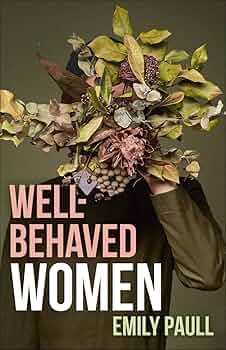
The Distance Between Dreams is your first novel, but it’s not your first book. Well-Behaved Women came out with Margaret River Press in 2019. Short stories and novels are obviously very different forms, but do you think writing short stories helped with your novel-writing?
Maybe. I think of them as very different things. I went through a phase of being very prolific with short fiction and I haven’t written any short stories really since that book came out. Perhaps the biggest lesson was in creating characters, but it’s hard to say.
Your bookish chops are pretty extensive. You currently work as a librarian, you formerly worked as a bookseller, you’ve interviewed countless authors, hosted panels at festivals, been shortlisted for writing awards and prizes, you review books, and mentor and provide feedback on works for other writers… Why do you think books and storytelling have been such an enduring part of your life?
Stories give us the roadmap to understand ourselves and the world, don’t they? Plus, they help you understand other people, and that can be really hard sometimes. There’s been a lot of research about the way that reading stories can help us build empathy and I truly think that empathy is the most important quality we can have.
I have also had periods of time throughout my life and particularly as a child where I felt quite lonely and like I was not understood by my peers. But books were always there for me, and the library was always my happy place. I like that I get to create that for other people now.
You’ve been a reviewer with the The AU Review since 2017; that’s 9 years of reviewing books for this publication! What insight do you have as both a reviewer and an author?
Reviews are not for authors. But also, reviews should be reviews and not personal attacks. I think the best reviews I have seen are the ones that look at what the author was trying to do, how successfully they achieved that, and who the ideal reader for a book might be, even if it’s not that reviewer’s cup of tea.
The one time I decided to look up my reviews, I found a fairly critical one – but, because the writer had been constructive and upfront about this not being their preferred genre, I was able to think, ‘Yeah, ok, that’s fair’ and move on.
Some book reviewers don’t always do that though, and for that reason, I don’t usually read my reviews! I’d give the same advice to most authors, just don’t worry about what the critics think.
Obviously, you’re a very well-read person. With that in mind, what books would suggest, if readers enjoyed them, they might enjoy your book too?
What a tricky question! I am going to sidestep it by saying a few books that were touchstone ones for me but that I would NEVER have the hubris to say my book is on a par with…
- Nine Days by Toni Jordan
- Elemental by Amanda Curtin
- Stranger in my Street by Deborah Burrows
- The Life and Loves of Lena Gaunt by Tracy Farr
- The Narrow Road to the Deep North by Richard Flanagan
Thanks so much for chatting with us and congratulations again. The whole AU team is so proud of you and can’t wait for your next book!
Emily Paull’s The Distance Between Dreams is available now through Fremantle Press. Grab yourself copy from your local bookstore HERE.
Cover image provided by the author.
