

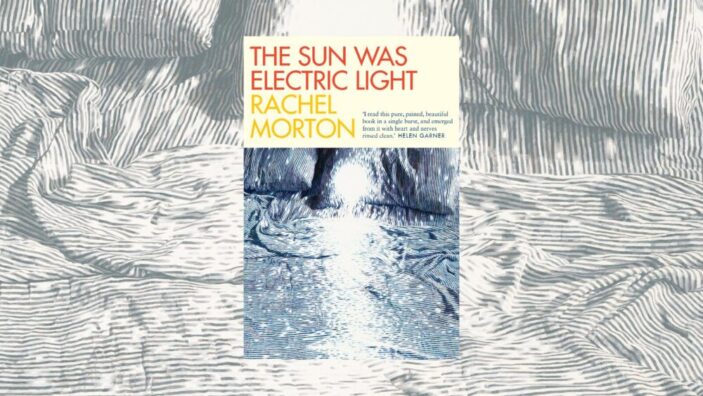
Atmospheric in a strange, almost empty way, The Sun Was Electric Light is the debut novel from Australian author Rachel Morton. As the winner of the 2024 Victorian Premier’s Literary Awards, it may come as no surprise to hear that this one is something truly special, meditative and evocative – or that this uniqueness comes at the cost of imperfection and of not quite suiting all tastes.
Dissatisfied with her life in the big city, a woman named Ruth decides to go to the one thing in this world she knows she once loved: a lakeside village in Guatemala she last visited ten years ago. But, the direction and purpose that she is seeking does not come easily, even here. As she stays, she meets two women who could both change her life: the practical Emilie, who has a career and a future that Ruth lacks, and Carmen, who has as little as Ruth does but who has embraced the lack of meaning her own life holds.
Over the course of these fragile years by the lake, as Ruth searches for purpose and belonging in the world around her and inside herself, her relationships with these two women change and shift, until she is forced to make a decision: to accept the discomfort of staying here, living in the moment without a future in place, or to go through the pain of change and find somewhere, something, new.
This novel is a strange one. Told in sparse, understated prose, the writing often feels simplistic – before getting underneath your skin with an evocative turn of phrase. It’s as floaty and as unmoored as Ruth is, and it holds a hazy, uncertain atmosphere in the gaps between the words. It moves slowly, hiding a thoughtfulness which occasionally rises above the turbulence of mundanity in moments of sublime clarity. A feeling akin to grief pervades it, but it takes time for it to cross from merely strange and a little intriguing to genuinely compelling.
After all, the novel does have a lot to explore – though searching for a purpose in a world that feels like it lacks meaning is the centre point, something that each of the characters come up against, there is more to it than that. It’s also about the places we inhabit, and what it really means to belong somewhere. It’s about connecting with other people, truly connecting instead of pretending.
I found it worth taking the time to sit with this novel and take it in, to sit with Ruth’s uncertainty and dissociation and afterwards, to rise with her. Initially, I found it interesting, but it didn’t truly draw me in until quite a ways into itself – though when it did, it left me feeling something I couldn’t quite name at the time, and this intrigued me. The simplistic writing of this novel is also an acquired taste, and those who prefer their literary fiction on the more flowery side might find it a little too plain. Similarly, there is the fact that the plot is as understated as the prose.
Though in the end I would say I did find The Sun Was Electric Light worthwhile, the time it took for me to reach this stage and the overall stiffness of the prose means that I cannot give it a recommendation without caveats. It is not a book that everyone will like. But it is a fascinating exploration of the search for that ill-defined ‘more than this’, and if you’re looking for literary fiction that feels a little different, something with atmosphere and emotion, I do recommend giving it a try.


THREE AND A HALF STARS (OUT OF FIVE)
The Sun Was Electric Light is available now from University of Queensland Press. Find it at your local bookstore HERE.
Header image supplied by University of Queensland Press.
