

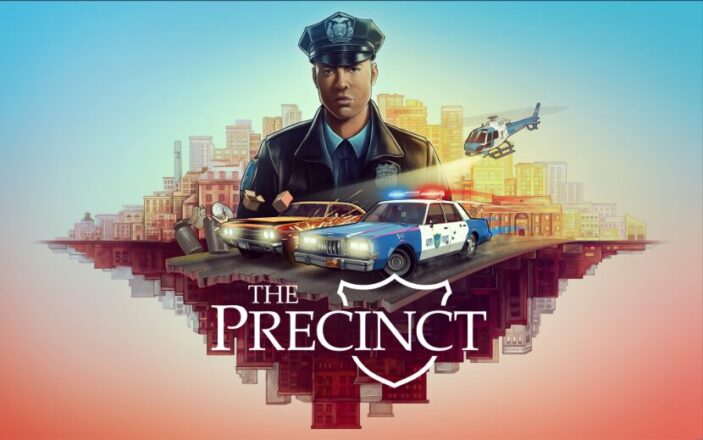
There’s a romance to policing in fiction that real life rarely lives up to. The flashing lights, the procedural rhythm and the legend of a lone beat cop fighting against a crime-ridden city. It’s built for drama, as television has proven since the 1970s. The Precinct, from American Fugitive developers Fallen Tree Games, taps into that fantasy with immense conviction. Set in the seedy neon glow of 1983 Averno City, the game is a top-down open-world police sim that puts the safety of the city and its citizens in your hands.
While it nails the look and feel of a retro cop show (tropes and all), The Precinct is far from a perfect open-and-shut case. The ideas are strong, the presentation slick, and the core loop is often remarkably satisfying. As you familiarise yourself with the rule of law, grow into the formula, and develop your skills alongside your character, there’s a genuine sense of achievement rarely captured in other games. Yet the systems seldom push deep enough to turn the crime-ridden sandbox into something truly dynamic, or make the badge and your efforts carry weight.
Give Me My Badge and Gun
At its heart, The Precinct is a game about routine, from the flow of gameplay to making the perfect arrest. Wake up, check your cases, hit the streets, and respond to a rotating cast of procedural callouts. It’s everything you’d expect from a cop simulator: car thefts, car chases, gang fights, armed robberies, shootouts. You can even write a parking ticket!
Sometimes you’re chasing suspects in a patrol car; other times you’re on foot, or even holding the spotlight in a helicopter. You respond to an incident, flip the sirens, subdue a suspect, and finish by filing the paperwork back at the station. On the surface, it sounds repetitive, but there’s an undeniable pleasure in doing it literally “by the book” and racking up points for booking perps to the letter of the law.
Correctly identifying a suspect, searching them, and choosing the appropriate charges can earn you more experience. This, in turn, unlocks useful upgrades like riot vans or roadblocks during chases. If you go rogue, however, your daily XP gains are wiped. It’s a surprisingly rigid system and one that encourages discipline in a genre typically obsessed with vigilante chaos.
It’s a nice antidote to the GTA-inspired open world chaos typically associated with the crime genre, and an itch that likely hasn’t been scratched for many since L.A. Noire. Although this system can be automated (and later on you’ll be leaning on this to get back to the action), it’s a nice touch.
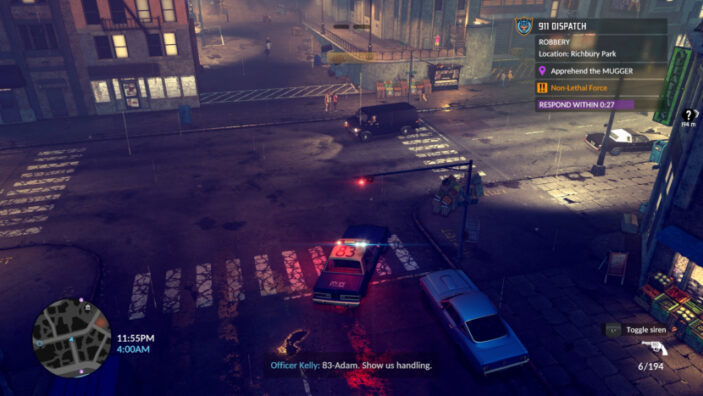
There’s a real rhythm to the game when it’s working as intended, like a procedural generator that just keeps spitting out crime. That rhythm is the best thing The Precinct has going for it and makes for some truly enjoyable and random moments. But despite the constant activity, Averno City never quite feels alive. You’re not a part of a bigger organism; you’re the only real moving piece.
The world doesn’t quite react in a myriad of satisfying ways, leaving the world feeling a little bit static. Additionally, for a game that leans into simulation, the world lacks consequence. You could respond to enough crimes to put Batman out of a job and still return to a city that feels like it’s been reset overnight.
Civilians also rarely react with nuance, and crimes are usually one-note. Even your interactions with other officers are purely mechanical, and often not helped by the otherwise highly tropey dialogue. The dialogue throughout the story feeds the retro throwback vibe but simultaneously undercuts the game’s attempts at seriousness. It leans heavily into the clichéd one-liners and hard-boiled exposition, which can deliver when done right. Here, it’s often charming in small doses but starts to feel forced eventually.
Chase the Perp, Solve the Crime, Drive Real Fast
Mechanically, The Precinct is a mixed bag. Driving is fast, loose, and easily the most joyful part of the experience. It feels purpose-built for wild chases through city blocks, especially when spike strips and roadblocks enter the mix. The camera swings and sirens blare, and in those moments, the game delivers on its pitch. Blaring your sirens while pulling handbrake turns down alleys in hot pursuit is almost worth the price of admission alone.
On foot, things fall short, however. The gunplay is floaty, janky and often unsatisfying. There is a noticeable lack of “thump” from your trusty service weapon that can be a little disappointing. The cover mechanics can also be quite literally hit and miss. On more than one occasion, my run was ended by semi-automatic-wielding criminals as I stood exposed while mashing buttons to reach cover.
Both car and pedestrian chases are initially quite the thrill once you master the mechanics. These can become repetitive after you subdue the same suspect model half a dozen times, but the novelty never really wears off. Combat encounters can also devolve into awkward stand-offs and all-out shoot-outs, rarely demanding much tactical nuance.
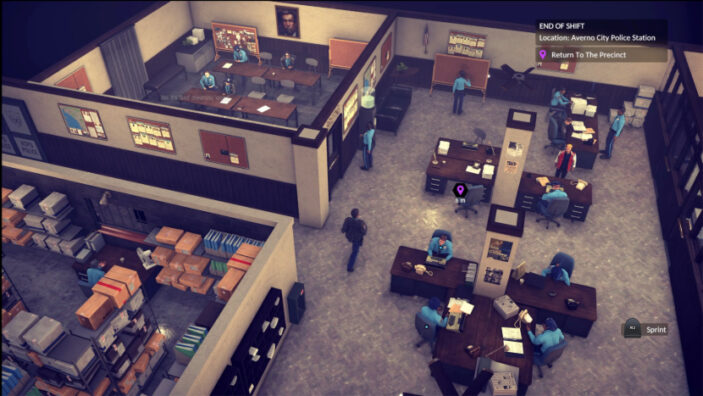
And yet, there’s still something addictive about the gameplay loop. It’s light, frictionless, and leans into the fantasy of the uniform, which is often enough to carry you a few days closer to retirement.
Law and Order: 1980 (DUN DUN)
Visually, The Precinct is excellent. Averno is a city of hazy sunsets, flickering neon, and crime scene spotlights slicing through the dark. It channels the 1980s not just through palette but through tone. The visual style is coherent and often gorgeous in motion. The isometric style means you might miss some of the finer details, which is a shame, as the world is nicely furnished and carries polish.
Clunky animations, stiff transitions, and the occasional bug do pull back the curtain just enough to break the illusion often enough, however. A few times, suspects clipped through walls mid-chase or froze in place. The technical jank doesn’t ruin the experience, but it does expose the game’s limited budget.
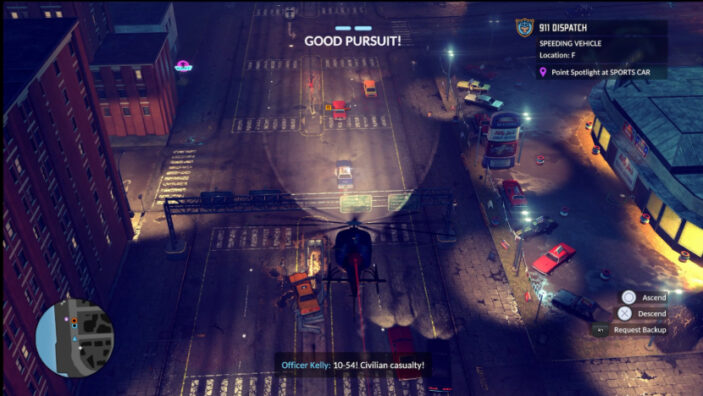
It’s also worth noting that while the world is big, it’s not particularly reactive. The world isn’t super lively or active, with the open world feeling much less lived-in than other titles. You can’t engage with the city outside of its roads and crime scenes. Civilians also have no discernible routine, and shops seemingly never close. Compared to the emergent chaos of something like GTA, The Precinct can feel more arcade-like than simulation. Despite that, the game still has enough charm to not allow the set dressing to blemish its core design.
Final Thoughts
The Precinct is bursting with potential, but paradoxically, maybe too much of it. It perhaps draws more attention to what it could be than what it is. The mixture of cop simulation, throwback arcade game, open-world sandbox, and detective story all at once is a difficult combination for even the most elite studios. And while it flirts with all those things, it never fully commits to any one of them. The result is a game that feels torn in too many directions.
Still, it’s a compelling foundation. The fantasy it sells of being a cop in a dangerous, stylised city is a good one. The systems just need more weight, more consequence, and more connection. If Fallen Tree Games can keep building on this post-launch, The Precinct could become something genuinely special.
Right now, though, it’s an atmospheric ride-along with a lot of promise, and a lot of paperwork.


THREE AND A HALF (OUT OF FIVE)
Highlights: Slick ‘80s aesthetic and atmosphere, fun car chase mechanics, satisfying procedural flow
Lowlights: Repetitive combat and suspects; Limited world interactivity, minor bugs and jank
Developer: Fallen Tree Games
Publisher: Kwalee/Microids
Platforms: PlayStation 5, Xbox Series X|S, PC
Available: Now
Review conducted on PlayStation 5 with a pre-release code provided by the publisher.
