

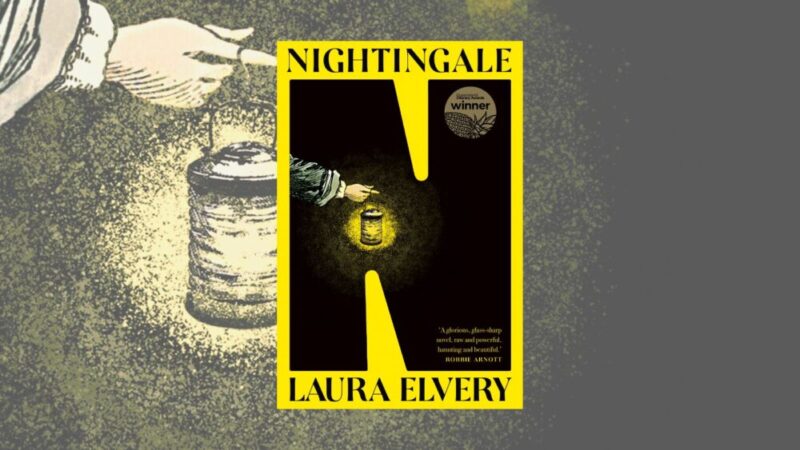
Florence Nightingale is a figure so well-known historically that her name has become a shorthand for describing someone virtuous and self-sacrificing in the care of others. But how much of the real woman, or indeed the period in which she lived do most people really know? In her debut novel, Brisbane-based writer Laura Elvery has turned her pen to digging deeper.
Though Nightingale may be Elvery’s first published foray into the longer form, she is a well established name in Australian literature, with two previous collections of short stories. Her second, Ordinary Matter, saw her take home the 2021 Steele Rudd Award. Elvery is a writer known for her sharp observations and precise approach to descriptive language, able to evoke beauty and heartfelt emotion in a short expanse of text without her prose turning florid. Her pivot into the novel form is no exception here, with not a word wasted despite the need to establish much more in the way of context for this ambitious novel. It is clear that the skills she has honed working with tight word limits have served her well, as the book is exactly as long as it needs to be for the premise to work.
In London’s Mayfair district in 1910, Florence Nightingale lies dying in her bed at the age of 90, kept company only by her maid of all work. Florence is in and out of consciousness, remembering snippets from her past including days spent with her mother and sister; and an owl that she nursed back to health as a child and then kept as a pet. This anecdote, perhaps, indicates that the famous nurse even thought of herself as preternaturally gifted in the field of caring, set apart from her peers by her determination and her ability to see all life as worth preserving. Throughout the book, Elvery peppers in details of the Nightingale mythology – her role in advocating for hygiene to be considered in preventing disease during the Crimean War in the 1850s, her importance to women being taken seriously as capable in battlefield hospitals, her stern and unemotional approach to the treatment of the wounded, and the high expectations for her nurses.
Yet the arrival of a man on Miss Nightingale’s doorstep suggests that perhaps there is something more far human and more fallible in her history than her legendary status would suggest.
This man is Silas Bradley, a soldier Florence Nightingale met during the war, some sixty years previously. He has not aged. His arrival there is impossible. Is he a deathbed apparition? The manifestation of something Florence Nightingale has felt regret over for the rest of her 90-year long life? Or is he truly both alive and not, ageless and deathless, wandering the earth in search of – what? Answers, closure, or something in between.
As Silas sits by Florence Nightingale’s bedside, their talk prompts both parties to recall a mutual acquaintance, a young woman named Jean Frawley. To Florence, Jean was a kind of protege, a very capable young nurse who served under Miss N but with whom she lost contact. To Silas, she was something much more intimate.
As both characters finally allow themselves to think about Jean, perhaps to admit to themselves what she meant to them (to Silas, love; to Florence Nightingale, a professional failure of sorts, or perhaps a moment where the need to be dispassionate in order to be efficient and effective in war meant that she was cruel to someone who needed her) the narrative of Silas’s visit gives way to a longer chapter, telling Jean’s story.
In many ways, this book does not follow a traditional structure, and the title of Nightingale is misleading. In fact, it seams to be Jean and Silas’s book, with a short story about their relationship bookended by the sections in Mayfair, many years later. Yet the writing style is gentle and compelling, and as a reader, I felt cradled and guided by the story, even as I was being asked to believe unbelievable things.
The real history of the war, and even of Florence Nightingale was somewhat irrelevant, I came to realise; it was Jean who was the heart of the story, just as she was the crux of the dilemma for each of the other characters to grapple with on the eves of their deaths.
In the hands of a less skilled writer, this book had the potential to become wishy-washy, overwrought and unnecessarily supernatural. But in the hands of one who honed her craft on the short story form, it is a sparkling literary gem, and deservingly found a place on the Queensland Literary Awards shortlist earlier this year.
Reminiscent of Elvery’s writing about women in science through history in Ordinary Matter, Nightingale proves that history can be a powerful element of literary fiction, and that you can do a lot with a little when it comes to establishing important context.
Read this one if you liked Salonika Burning by Gail Jones or Devotion by Hannah Kent.


FOUR STARS (OUT OF FIVE)
Laura Elvery’s Nightingale is out now through UQP. Grab yourself a copy from your local bookstore HERE.
